2026 Theses Doctoral
Leveraging relatedness in genomic datasets to study variation in germline mutation rates
Germline mutations are the source of all heritable genetic variation and a fundamental driver of evolution. When transmitted, they are present in every cell of the offspring, and a subset contributes to heritable diseases and cancer predisposition. Yet the number of inherited de novo germline mutations differs among individuals. Most of this variation is explained by parental age, but the remaining variance, which likely reflects genetic and environmental influences, is not yet fully understood. Characterizing these influences requires large, population-representative catalogs of de novo mutations, which have been difficult to obtain at scale using traditional approaches.
In my doctoral work, we develop a sibling-based approach to identify de novo mutations at scale by leveraging nucleotide differences within genomic regions shared identical-by-descent from both parents between pairs of siblings. To that end, we developed a stringent quality control, informed by analyses of monozygotic twins, genomic duplicates, and families with both sibling and parental data. Application of this approach to the UK Biobank and All of Us datasets yields a catalog of ~853K de novo point mutations across 28,985 sibling pairs and 2,330 parent-offspring trios, derived from 27,645 sets of parents of diverse genetic ancestries. Mutation counts and spectra are consistent with previously published DNM catalogs, validating the approach, and our catalog is comparable in size to the largest dataset of de novo mutations.
We used this set of de novo mutations to characterize the sources of inter-individual variation in germline mutation rates. Contrary to previous reports, we find no significant differences in mean mutation rates across ancestry clusters. We also do not find evidence for the excess of TCC>TTC mutations previously inferred in Europeans from polymorphism data; this finding is consistent with the estimated timing of its origin, which predates present-day populations, suggesting that ancestry-associated differences in polymorphism data may reflect genetic modifiers no longer segregating or environmental influences that have since changed. Subtle shifts in C>T proportions are nonetheless observed across ancestry clusters; as we show, these cannot be explained by differences in mean parental age or by quality control filters and may instead reflect genetic or environmental influences. We also do not find an association of tobacco use with differences in DNM counts or spectra, suggesting that the germline mutation rate is relatively robust to this exposure.
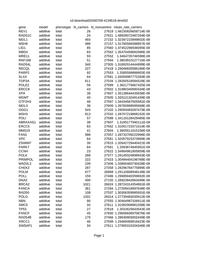
To investigate the genetic architecture of germline mutation rates, we impute parental genotypes at loss-of-function and deleterious missense variants across 180 DNA repair genes. Despite their well-established roles in somatic mutagenesis, damaging variants in BRCA1, BRCA2, PALB2, EXO1, RIF1, and MLH1 show no association with germline mutation rates, and the characteristic somatic signatures are largely absent in carriers, suggesting that the germline may be better protected against such effects of compromised repair activity. In contrast, burden tests reveal that disrupting variants in several other DNA repair genes do leave a detectable imprint on the germline: most notably REV1, a translesion synthesis polymerase, associated with a 16% increase in total mutation rate, and LIG1, a DNA ligase involved in base excision repair, associated with a 24% increase in CpG>TpG mutations. These findings provide evidence that damaging variants in DNA repair genes that subtly influence both the rate and spectrum of germline mutations are segregating in population cohorts of humans. These results carry implications for the genesis of developmental disorders, cancer predisposition, and the evolution of mutation rates in human populations.
Subjects
Files
-
 gsas-dissertations-000703.pdf
application/pdf
5.75 MB
Download File
-
 S_vg2521_20260607_213444.csv
text/csv
162 KB
Download File
More About This Work
- Academic Units
- Biological Sciences
- Thesis Advisors
- Przeworski, Molly F.
- Degree
- Ph.D., Columbia University
- Published Here
- September 9, 2026
Notes
Computational Biology, Computational Genomics, Statistical Genetics, Population Genetics
