2024 Reports
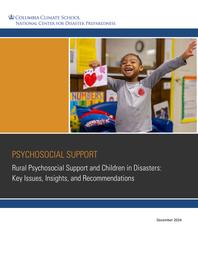
Rural Psychosocial Support and Children in Disasters: Key Issues, Insights, and Recommendations
Psychosocial support, or the facilitation of social and holistic well-being of people through the support of family and friends and community resilience, is a foundation for child well-being. As compared to specialized clinical mental health services, psychosocial support is a broader, community-focused approach.
An inadequate number of mental health professionals are available to provide services for the growing mental health burdens for U.S. children and families, especially in rural areas. Rates of childhood depression and anxiety overall have been increasing over time, but children who are exposed to repeated traumatic events that are especially common to those living in poverty and members of marginalized racial and ethnic groups are at greater risk of developing mental health disorders and dropping out of school. Furthermore, research reports that rural children often experience more adverse childhood experiences than urban children. These experiences can undercut a child’s sense of safety, connectedness, and autonomy, leading to further manifestations of physical and mental health issues in both childhood and adulthood. These manifestations indicate a need for further care to help heal extensive trauma that has occurred due to systemic and historical injustices. Psychosocial support emphasizes the role of support structures offered by community organizations, family units, and other social circles in positively affecting adults’ and children’s ability to retain a sense of autonomy and resilience.
While psychosocial support can supplement mental health support in rural communities, there are numerous barriers to its use and implementation. Mobile health clinics and task-sharing programs have faced difficulties in terms of adequate funding, licensing of paraprofessionals, and stigma within the community. The stigma against seeking care remains high, and parents who are hesitant to provide permission can negatively influence their children’s mental health. Faith-based organizations and other paraprofessionals have provided critical resources for children and families in rural America. So have school-based health centers, which ensure more equitable access to support services by limiting transportation barriers and using a family-based approach.
Disaster’s strain existing systems and services for psychosocial support by drawing away service providers, increasing caseloads, and revealing the fragility of existing services. For many families in rural communities, COVID-19 demonstrated how challenging a long-term resource strain can be. For example, there was a 7.40% national increase in unemployment from 2019 to 2020, with a 9.74% increase in rural areas. While COVID-19 provided many residents in urban areas with greater access to telehealth mental health services and case management, those in rural areas largely struggled with inconsistent internet access.
While life-sustaining service remains the priority of immediate response in an emergency, psychosocial support and other mental health services are critical for recovery in rural communities. By shifting service priorities to meet the needs of children and families in the immediate aftermath of a disaster, there is potential to increase the likelihood of economic and social recovery. The National Center for Disaster Preparedness has outlined a number of recommendations to address psychosocial support needs in rural communities. Further resources are described in the full version of this report.
Geographic Areas
Subjects
Files
-
 NCDP-Rural_Psychosocial_Support_and_Children_in_Disasters.pdf
application/pdf
809 KB
Download File
More About This Work
- Academic Units
- National Center for Disaster Preparedness
- Published Here
- September 14, 2026
Related Items
- Part of:
- Rural Preparedness and Children
Notes
Suggested citation:
Heard, E., & Sury, J. (Anita Drever). (2024b). Rural Psychosocial Support and Children in Disasters: Key Issues, Insights, and Recommendations (Rural Children and Disasters in the United States). National Center for Disaster Preparedness, Columbia Climate School, Columbia University. https://doi.org/10.7916/7k1h-pr55
