2024 Reports
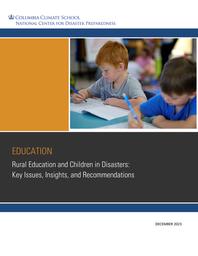
Rural Education and Children in Disasters: Key Issues, Insights, and Recommendations
Schools are among the most critical institutions for child development, providing children with a safe and nurturing environment in which to learn, critical food and nutrition, social and emotional learning, and psychosocial support, among other benefits. In the United States today, there are 53 million children enrolled in school from kindergarten through grade 12, and 9.8 million attend rural schools. Data suggest that Americans are increasingly better educated, a trend that includes both urban and rural communities. In 2000, 24% of rural (or non-metro) residents had less than a high school diploma. Yet, between 2017 and 2021, that number was nearly cut in half, with just 13% of rural residents falling into this category.
To overcome the obstacles discussed throughout this report and improve education efforts in rural America – both pre- and post-disaster – the National Center for Disaster Preparedness has outlined several recommendations. Additional recommendations and educational policies or resources available to families in rural areas are included in detail in the full report.
Geographic Areas
Subjects
Files
-
 NCDP-Rural_Education_and_Children_in_Disasters.pdf
application/pdf
670 KB
Download File
More About This Work
- Academic Units
- National Center for Disaster Preparedness
- Published Here
- September 14, 2026
Related Items
- Part of:
- Rural Preparedness and Children
Notes
Suggested citation:
Hansen, S., & Sury, J. (Emily Heard,Anita Drever). (2024b). Rural Education and Children in Disasters: Key Issues, Insights, and Recommendations (Rural Children and Disasters in the United States). National Center for Disaster Preparedness, Columbia Climate School, Columbia University. https://doi.org/10.7916/237a-jx06
